Amerigo Bonasera
The GodfatherAmerigo Bonasera is a New York undertaker whose defining encounter with Vito Corleone exposes the gap between formal American justice and the private justice administered through the Corleone Family. After the court releases the two young men who attacked his daughter, Bonasera moves from faith in citizenship and law to dependence on a criminal patron. His submission is not merely a request for revenge: it is the moment when a respectable immigrant professional accepts that protection, friendship, and debt may carry more force than the institutions he had tried to honor.
Identity and Public Respect
Amerigo Bonasera lives only a few blocks from his undertaking establishment on Mulberry Street and returns home for supper before resuming his evening duties among mourners. He resents jokes about the macabre details of his profession, insisting through his conduct that any occupation deserves respect when it allows people to earn their bread through labor. His solidly furnished apartment, the statues of the Virgin Mary with red-glassed candles, his cigarette, and his glass of American whiskey present him as a settled, observant, and respectable member of the community rather than as an underworld figure.
That public respect is also why his humiliation in court cuts so deeply. Bonasera has tried to be a good American and wanted his child to be American, yet the legal system treats his daughter’s suffering as negotiable. The judge condemns the young men as degenerates and wild beasts, but then suspends their three-year sentence because of their youth, clean records, and fine families. The court’s theatrical severity therefore ends in practical impunity: Bonasera’s daughter remains in the hospital with her broken jaw wired together while the offenders leave confidently and without even looking at him.
The Courtroom Failure and the Appeal to Vito Corleone
Bonasera waits in New York Criminal Court Number 3 for justice and vengeance, but the proceedings reveal a social hierarchy beneath the language of law. The judge’s contempt appears to Bonasera as something false, and the lenient sentence confirms that the young men’s families and political connections matter more than the injury inflicted on his daughter. His professional control barely conceals his hatred; black bile rises into his throat as he presses a white linen handkerchief to his mouth and watches the two men walk away.
He attends Constanzia Corleone’s wedding because his wife is a close friend of Vito Corleone’s wife, but he is already in severe disfavor with Vito. In the corner room, Bonasera begins indirectly, reminding Vito that his daughter is the Don’s wife’s goddaughter and explaining that she is still in the hospital. Vito answers that he knows of the misfortune and could help, but the offer is also a rebuke: Bonasera has never addressed him by the customary title of Godfather. The request is therefore governed by a relationship Bonasera has previously refused to acknowledge.
Bonasera insists that he wants justice, not the court’s version of it. When Vito distinguishes between the justice given to the youths and the justice denied to the injured father, Bonasera states the principle he has come to demand: an eye for an eye. He asks that the young men suffer as his daughter suffers and, in despair, asks how much he must pay. His language shows that he still imagines Vito’s intervention as a transaction, while Vito treats it as a question of allegiance.
Submission to the Godfather’s System
Vito rejects the idea that Bonasera should purchase justice as a commodity. He contrasts the slow courts, expensive lawyers, banks, and corrupt judge with the immediate protection that would have been available had Bonasera first offered friendship. Under Vito’s system, an enemy of an honest friend becomes Vito’s enemy; protection is personal, direct, and backed by fear rather than by procedure.
Bonasera finally bows his head and asks Vito to be his friend. Vito places a hand on his shoulder and grants the requested justice, calling it a gift from his wife, the girl’s godmother. The gift is not free in the deeper sense. Vito warns that some day, perhaps a day that may never come, he will call upon Bonasera to perform a service in return. Bonasera has entered the Godfather’s system of favors, where friendship is publicly proclaimed, gifts signify indebtedness, and a debt may be redeemed whenever the patron chooses.
The response to Bonasera’s appeal is carefully separated from Vito’s visible authority. Vito gives the affair to Peter Clemenza and orders him to use reliable people who will not be carried away by bloodshed. The operational chain runs from Vito to Tom Hagen, from Hagen to Clemenza, and from Clemenza to Paulie Gatto, so that the men carrying out the punishment do not know the original source of the order. Bonasera’s private grievance thus becomes an example of how the Corleone organization converts personal obligation into concealed institutional action.
Fear, Punishment, and the Return of the Debt
Bonasera’s fear does not end when Vito grants his request. He has a terrible nightmare in which Vito, dressed as a laborer and unloading bullet-riddled corpses outside the funeral parlor, orders him to remember the service and bury the bodies quickly. The dream makes visible the moral cost of the bargain: the justice Bonasera requested may bind his professional skill to the violence of the Family. His wife wakes him and mocks the timing of the nightmare, but the dream remains an unconscious recognition that he has invited death into the space where he handles the dead.
The concrete consequence is later shown at Bonasera’s establishment. He sends his daughter to Boston to live with her mother’s sister, allowing her to forget the assault and the injuries inflicted by the two punished men. At supper, he and his wife live with the aftermath in a household marked by religious objects and domestic order, while the daughter’s absence records the lasting damage that neither the court nor Vito can erase.
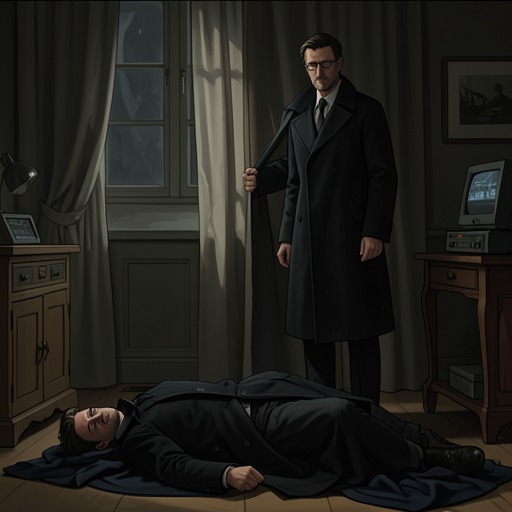
When Clemenza eventually arrives at the undertaking establishment with rough young men and an ambulance, Bonasera recognizes that a new obligation has matured. A corpse lies on the stretcher beneath a gray blanket, its bare yellow feet protruding from the end, and Vito enters the office after the bearers. Vito has lost weight during his illness and looks older and diminished, yet he still radiates power. Holding his hat against his chest, he asks Bonasera whether he is ready to do him this service. Bonasera nods, accepting the role that Vito’s earlier promise had reserved for him. The undertaker’s professional skill, once associated with respectable civic life, is now summoned as part of the Godfather’s reciprocal economy.
Narrative and Thematic Significance
Bonasera’s story establishes the novel’s central contrast between state justice and the Mafia as an alternative government. The judge invokes the majesty of law, but the sentence protects privileged families; Vito condemns the court’s corruption, yet his own remedy depends on intimidation, secrecy, and a chain of men who can be removed if necessary. Neither system is morally simple. Bonasera’s daughter receives no adequate restoration from the court, while Vito’s intervention gives the father a form of recognition and redress at the price of permanent indebtedness.
His movement is therefore a reversal rather than a triumph. He begins by defining himself as a good citizen who trusts American institutions and ends by proclaiming friendship to Vito Corleone. The line between respectable society and organized crime is not presented as a wall but as a series of exchanges: a wedding invitation, a godparent relationship, an appeal for help, a promise of service, and finally a corpse delivered to the undertaker’s door. Bonasera does not become a public gangster, but his dependence on Vito shows how the Corleone Family’s authority expands through people who seek protection when official institutions fail them.
Bonasera also gives the novel one of its clearest studies of competing ideas of justice. The courtroom offers punishment in name but not in consequence; Bonasera asks for retaliatory suffering; Vito offers a controlled private remedy framed as friendship; and later the wider Families negotiate rules governing drugs, violence, executions, and mutual assistance. Against these systems, Bonasera’s experience demonstrates that justice is never merely a legal judgment. It is also recognition, protection, memory, and the power to make another person answer for harm. His tragedy is that the only authority willing to answer his appeal is an authority that converts gratitude into obligation.